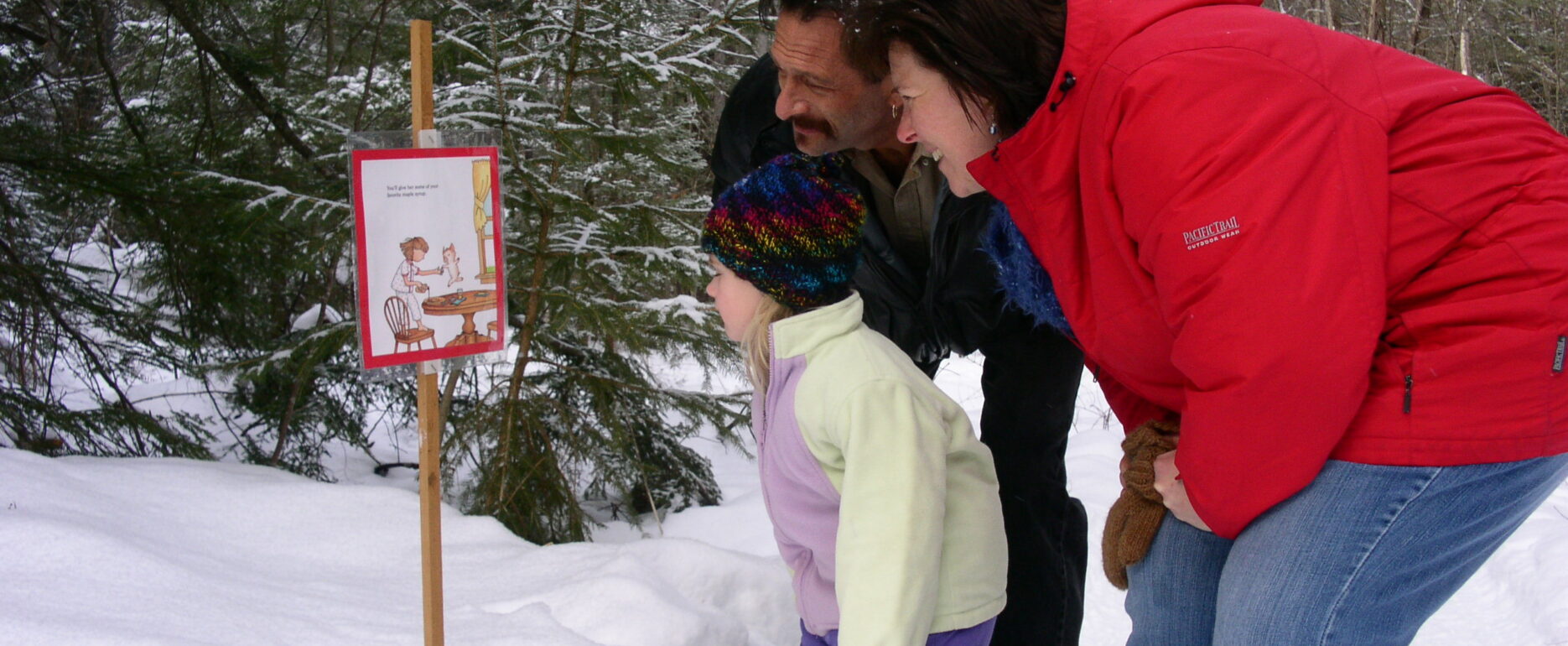
Family looking at StoryWalk

Combine reading and the great outdoors with StoryWalk®!

StoryWalk® promotes early literacy, physical activity, and family time together in nature. It’s a fun and educational family activity that you can bring to your community! Take a stroll and enjoy successive pages from a children’s story along your path.

StoryWalk® was created in 2007 by Anne Ferguson of Montpelier, VT, in collaboration with former KHL staff member Rachel Senechal, and is a registered service mark of the Kellogg-Hubbard Library. StoryWalk® now exists across the U.S. and worldwide in 13 countries including Germany, Canada, England, Bermuda, Russia, Malaysia, Pakistan and South Korea!

If you are in Vermont, you can borrow a StoryWalk®  from our collection. If you are outside Vermont, get in touch to learn how to get started building your own! All it takes is laminating pages from a children’s book, attaching to wooden stakes, then installing along an outdoor path.

For all questions about StoryWalk® , please email [email protected].

The Benefits of StoryWalk®

StoryWalk® provides early literacy opportunities to young children. Sharing the reading of a StoryWalk book stimulates and fosters the development of strong listening and speaking skills. StoryWalk also helps to build a child’s vocabulary which is important to thinking and learning. Developing early literacy skills leads to better preparation for school.

StoryWalk® provides a teaching moment for a child’s first teacher – their family. Children and their families can read the book together then discuss the text, illustrations and meaning of a great book. Many StoryWalk books have a theme: kindness, anyone can make a difference in someone’s life, a love for nature, accepting differences, and more.

StoryWalk® provides a wonderful avenue for outreach and collaboration. StoryWalk is a tool to bring the library out to the community with the goal of increasing visibility of the library. Some people may experience StoryWalk at a school or park and never walk into the library. StoryWalk may be the gateway for people to come to the library.

StoryWalk® FAQs

How do I build a StoryWalk®?

Carefully remove the pages from two copies of the book you’re making into a StoryWalk.  Mount each page on card stock (you need two copies so you can mount the front and back of each page), mark the back of the cardstock with the page number, book title and owner contact info to keep them in order, then laminate with 10 ml laminating pockets.  Apply a strip of Industrial Strength Sticky Back Velcro® to the back of each page and use a staple gun to affix the other side of the velcro to a 4-ft garden stake.  When the StoryWalk book is attached to the stake, the pages are at eye level for young children and the pages are vertical so that they resist fading and sun damage.

What are the costs involved?

If you live in Vermont, you can borrow a StoryWalk® book from us and the cost is free!

If you want to create StoryWalk books yourself, here are the costs: We purchase 3 copies of each book (2 for mounting, one for damage repair/replacement); books cost between $7 and $20 each so that can range from $25 to $55. Lamination costs about $3 for 10 ml – a range of $90 – $100 for each book depending on its length. Stakes (good ones that don’t splinter, aren’t heavy, won’t break easily) cost $1 each – most books need about 30. Sticky backed industrial strength Velcro® to hold the books onto the stakes cost about $35 that will accommodate a 30-page book. Not including labor to assemble and mount the books, StoryWalk® costs run about $200 – $250 per book.

We encourage you to consider a donation to the Kellogg-Hubbard Library to support this program.

What about copyright laws?

When we launched StoryWalk, we contacted the then head of the Children’s Library Services for the State of Vermont who, after consulting with the the State’s legal counsel, told us that if we purchased the book, we could use them in the stated format.

The books can not be altered in any way, the pages cannot be enlarged, scanned, or reproduced. Only mount them on card stock and laminate each individual page.

Any other form of use requires permission from the copyright holder, including audio recordings and translations.

What is required of me if I would like to offer StoryWalk® in my community?

Please use the StoryWalk® trademark and include the following statement in all promotion of the project:

“The StoryWalk® Project was created by Anne Ferguson and developed in collaboration with the Kellogg-Hubbard Library in Montpelier Vermont. Storywalk® is a registered service mark owned by the Kellogg-Hubbard Library.”

Storywalks must be educational, noncommercial projects used to promote early literacy, physical activity, and family time together in nature.

How can I help support the StoryWalk® Project?

Thanks for asking! Donations are always welcome and can be made via the Kellogg-Hubbard Library website.

How do you select books for The StoryWalk® Project?

Focus on minimal text, using books with illustrations that don’t cross the center of the book, and a great story line.  Look for books with 30 or fewer pages.  We often find seasonal and nature-based books to be the most popular.

How far apart did you space the pages?

That depends on the length of the route available, the number of forks or intersections it has and the number of pages in the book. Make sure that the readers know where to find the following page, it is best if the next page can be seen. About 40 paces or so seems like a good distance between pages. We have found that a half-mile works well for small children.

How can you tell how many people have seen the StoryWalk® ?

You can place a guest book at the end of the StoryWalk® and ask readers to tell us the date, number in party, and any comments or suggestions that they have for the project.

We have placed a loose-leaf binder in a weatherproof box along with pencils (pens freeze and won’t write on damp paper). The boxes are ones developed for real estate information with lids that can be mounted or attached to stakes.

What's the history of StoryWalk®?

Written by Anne Ferguson, StoryWalk Founder

When I created the StoryWalk Project in 2007, I knew I had a great idea; I just didn’t anticipate how well it would be received across the country and beyond. The idea was quite simple actually. Take the pages from a children’s picture book, attach each one to a stake and line them up along a path for folks to read and enjoy.

One of my supervisors told me that the secret to promoting a health message was “partners, partners, partners,” as many and as varied as possible. I was working as a chronic disease prevention specialist at the time and knew that I wanted to create something different, fun, and interesting. I had tried some different approaches involving children but found that the parents stood around chatting while the children were physically active. I knew I wanted to create something where the parents had to be as active as the children. Active parents have active children and physical activity is a key component to chronic disease prevention.

In order to keep people of all ages moving along on a walk, I knew I needed books with minimal text that would appeal to all ages (especially children) and that could fit into families’ busy schedules. I wanted my project to be free so financial limits would not interfere with people enjoying it. I fleetingly thought about writing a children’s book myself but knew there were already marvelous, funny, beautiful, and moving stories available.

I wanted to use existing books but didn’t know about the legalities of doing that. I made some calls and found out that if the book is used without altering the text or the page in any way (shrinking, copying, or enlarging the pages), I could use it without needing to ask for permission.

I had no money and no staff for this idea so I knew it would have to be self-generated. I contacted the early literacy person at the Vermont Arts Council who immediately gave me $250 to start the project. My employer gave me one month to try it. I purchased David Ezra Stein’s book Leaves and started preparing it for posting. I selected the most popular path in our local park and put out a notebook for feedback.

The response was tremendous and positive. Unfortunately, my employer told me I couldn’t continue focusing on StoryWalk. So I went ahead with it on my own time. I applied for and got a grant so I could purchase more books, lamination, and stakes.

I learned a lot about how to prepare the books for posting. I learned that I needed to number the pages on the back to ensure that they were posted in the correct order, I learned that it is best to use Velcro® on the stakes and the book pages, I learned that I could loan the StoryWalk books out through my partner, the Kellogg-Hubbard Library. I learned that the partners in my community that were interested in this project included state and local parks, schools, nature centers, child care centers, farmers markets, walking path promoters, special event promotions, but most of all, libraries.

Vandals are a recurring challenge. They seem to be threatened by a story about Gossie, a small duck who has misplaced his red rubber boots. A range of approaches has been used to address this issue, some with greater success than others. The Velcro® makes it easy to take down the pages before dark and post them again in the morning. Vandals prefer the cover of darkness.

StoryWalk was never designed to be a money-making project. In fact, it is now supported solely by donations from the public. It has always been about promoting early literacy, physical activity, and family time together in nature. Its success is due to partners, partners, partners that understood from very early on how this idea could be used to bring a fun and educational family activity to their community. That is indeed the reason that in the 10 years since I created StoryWalk, it has spread to (at the last count) all 50 states and 12 foreign countries. People everywhere are encouraged to bring it to their community.

Without the support of the library and in particular, Rachel Senechal, Program Director and Development Coordinator, this project would not be as well known and widespread as it is today.
I’m in Vermont and I would like to borrow a StoryWalk®...

StoryWalk books are available right from our library catalog!  If you are a KHL member you can borrow them directly.  If you are a Vermonter, you can request them via interlibrary loan from your local library, and either arrange to pick them up here or at any courier library in the state!

We are currently not able to ship StoryWalks outside Vermont.

What suggestions do you have for someone interested in creating a StoryWalk® Project in their town?

If you live in Vermont, you can borrow StoryWalk books (see the prior FAQ!)

If you don’t live in Vermont or would like to create your own StoryWalk, start by finding some other like-minded people in your community to work with on this project. We work well as a team and offer different perspectives and experiences. This project combines the benefits of physical activity, time outdoors in nature, literacy, and family time. Because of that, many community partners are interested in StoryWalk and it lends itself to funding from different sources.

Post StoryWalk books on new trails and paths to draw people to walk there or introduce them to StoryWalk by posting the books along popular routes. In winter, books can be posted in store windows where many people walk because the sidewalks aren’t so slippery or outdoors along snowshoe trails.

Try to involve other members of the community in the project in different ways; StoryWalk lends itself to creative adaptations. Our senior center group translated a book into French for us. A local high school Spanish class translated one for us as well. A children’s nature center was inspired to write and illustrate their own books.